News
News
Postamentet: small companies and digital twins
Postamentet AB is one of the smaller Swedish property owners that has moved quickly with digitalisation. Here is how digital twins from Vyer solved their biggest operational challenges.

Axel Buhlmann
Customer Success Manager
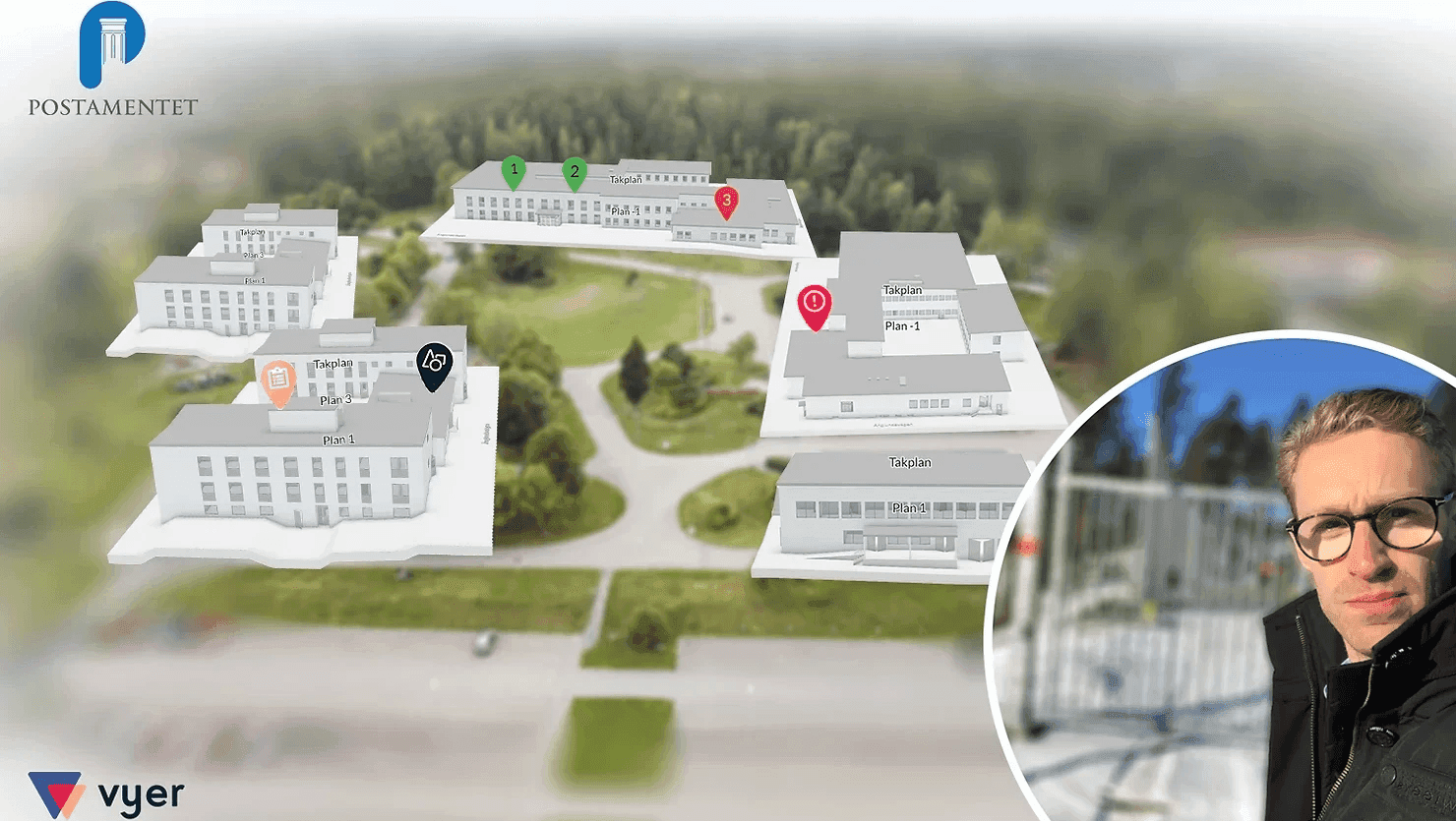
Privately owned property company Postamentet AB is one of the smaller Swedish property owners that has made significant progress in its digitalisation work in a short time. Just over a year ago, the company introduced digital twins from Vyer to simplify collaboration and increase the ability to manage properties remotely.
We save time on the practical workflow and get a better overview of the property, what is happening and what is being done. There is great value in that, which is difficult to put a price on.
— Thomas Heaster, property manager and owner, Postamentet AB
Digitalisation is high on the agenda for most property companies, but investment decisions often differ due to factors such as resources, complexity and objectives. Postamentet, which focuses on the long-term development of socially critical properties, owns and manages a property in Flen leased to the Swedish Migration Agency. With 20 buildings totalling 19,000 sqm, the property forms its own block in an old hospital area.
As long as there are a few people working on the property and there is a need to share information, a digital twin is useful.
— Thomas Heaster
Goals and benefits of digital twins at Postamentet
Better overview of the property's condition and processes — providing increased control and improved opportunities for remote management and collaboration between staff across geographical distances. Streamlined work order management — location-based work orders, fault reporting and PDF exports of documentation for external contractors enable rapid localisation and resolution. Straightforward accounting reconciliation — a unique work order number simplifies matching invoices against work orders in the system. Efficient inspections with drawing support — simplified execution, follow-up and documentation of systematic fire safety management with map support and automatic work order creation when a deficiency is reported. Access to fault and remedial action history — increased ability to analyse patterns and make informed decisions. Documentation of staff knowledge — transferring knowledge from staff to a shared system strengthens the organisation during personnel changes and retirements.
Needs and objectives guiding the digitalisation decision
Thomas Heaster's decision to invest in digital twins grew from the business's need for better control of its information for efficient work processes, and the ability to manage more of the operations remotely.
I am based remotely in Varberg, and we have an operations technician and a caretaker on site. The digital twin solved many of our problems around keeping track of things and exchanging information.
— Thomas Heaster
The goal going forward is to connect and document all operationally critical information to the digital twin, which will become the hub of the operation, to strengthen the organisation long-term.
Our operations technician has worked for us for ten years and will retire in a few years — all his knowledge of the property will disappear with him. So for us, this is also about transferring that knowledge to Vyer so that the next operations technician does not start from scratch, but can browse the system.
— Thomas Heaster
Rapid transition possible for smaller property companies
One advantage of having a smaller organisation is that Postamentet has been able to adapt to new digital ways of working relatively easily and quickly see effects in day-to-day operations.
It has worked well to establish new routines and make sure we are doing the right things. We save time on the practical workflow and get a better overview of the property, what is happening and what is being done. There is great value in that, which is difficult to put a price on.
— Thomas Heaster
It is a major improvement in how we work. We save time on every work order and it is appreciated by both our contractors and by us.
— Thomas Heaster
Staff now continuously map technical information about the property and actively work with location-based work orders and fault reporting from tenants and residents, as well as carrying out and documenting their systematic fire safety management in the digital twins.
When faults are marked on the drawing, the risk of the person who needs to fix the fault having to run around looking for it, or fixing the wrong thing, is reduced. I have not received any such complaints and that is a clear advantage.
— Thomas Heaster
The fault and remedial action history linked to locations and components builds up in the twin and also serves as a support for analysis and decision-making.
If we see, for example, that there are often blockages in the drains in one place, we come to the realisation more quickly that it may not be the sink but a system that needs to be looked at. Previously we went more on instinct — there was no documentation of where the faults are and how often they occur. Now we get real insight into that and can use it when we make decisions.
— Thomas Heaster
Axel Buhlmann
Customer Success Manager
More news