News
Guide
Guide: reduce staff dependency with digital twins
Property technicians carry critical knowledge about their buildings. When they are away, that knowledge goes with them. Here is how digital twins help you reduce staff dependency in facility management.

Axel Buhlmann
Customer Success Manager
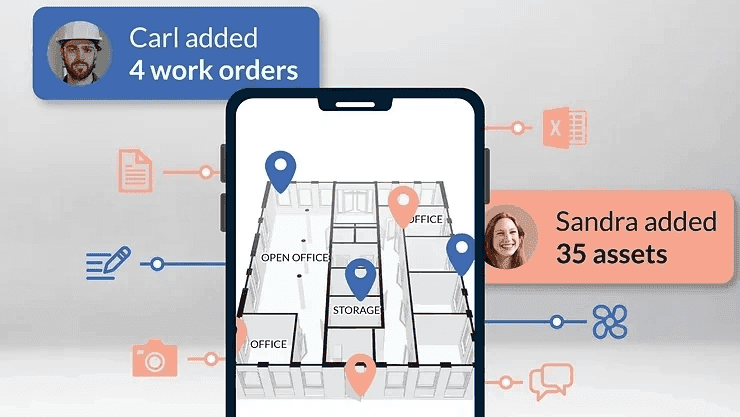
Property technicians often have a detailed understanding of building operations and the technical equipment in their properties. But knowledge that lives only in people's heads becomes a challenge when staff leave or are away for an extended period.
By digitalising and making critical information about your properties accessible, you can close knowledge gaps and make it easier for staff and on-call personnel to quickly get up to speed with what needs to be done.
"When I or one of our technicians or property managers goes home at the end of the day, gets sick or takes holiday, we take the knowledge of where everything is with us. That's exactly the kind of information that lives in people's heads — and that you want to have digitally so someone else can easily take over," says Fredrik Melander, property manager and PropTech coordinator at Heba, one of the drivers of the company's digitalisation process.
The digital twin as a collaboration tool
Building a digital twin is fundamentally about increasing access to information about your properties and ensuring that the people whose work depends on having the right information at the right time can easily access it.
The twin consists of web-based drawings combined with collected data about your properties, buildings, spaces, technical equipment and other components, as well as facility management processes and their status. Among other things, you can search and view floor plans in 2D and 3D, detailed information about technical equipment including location, serial number, installation date and operating instructions, how spaces are used and managed, fault reports and remedial actions, preventive maintenance rounds and inspections, and a full log of who added what information and when.
Step 1: Digitising and visualising drawings
The process of building a digital twin begins with collecting and digitising existing drawing records. The drawings are visualised in 2D and 3D on a digital platform that allows operations and facility management staff, as well as other stakeholders, to interact with the drawings and the data they contain.
"Just today we received a question from a tenant who didn't know where the recycling room was in the building. I helped them by emailing a 3D image of the property with both their apartment and the recycling room marked. They could then see from the drawing how to get there. Being able to give tenants relevant information quickly strengthens our customer relationships," says Fredrik Melander.
Step 2: Mapping components and knowledge
Once the drawings are in place, operations and facility management staff can start adding their knowledge directly to the digital twin. The more information that is added — components, equipment, routines, notes — the more useful the twin becomes for everyone in the organisation.
Step 3: Using the twin in daily operations
With a complete and up-to-date digital twin, staff can prepare for site visits remotely, on-call personnel can find their way around unfamiliar buildings, and new employees can get up to speed faster. The knowledge stays in the system — regardless of who is on holiday or has moved on.
Axel Buhlmann
Customer Success Manager
More news


