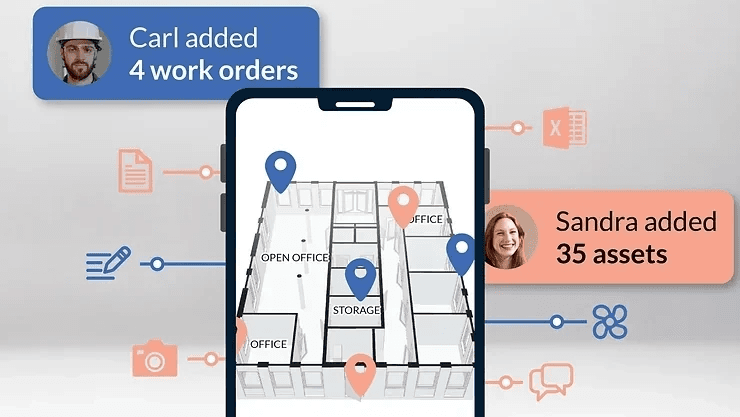
This is how Revelop works with digital twins to map rental properties and establish LOA.
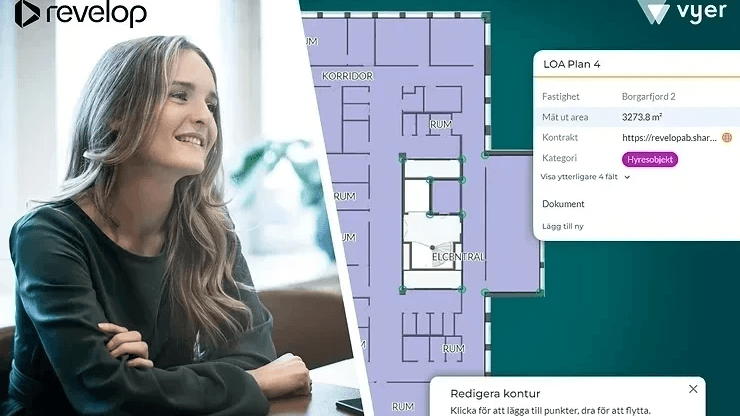
Sofia Segolsson, property coordinator at Revelop, lays the groundwork for streamlining the management's work with digital twins in Vyer. Photo: Revelop/Vyer
The property company Revelop is collaborating with Vyer to digitize drawings and building information to streamline operations and management across the entire portfolio. As part of the work, they are now actively working to inventory rental objects and determine rentable area (LOA).
"Previously, we hired external specialists to measure LOA and spent a lot of time and money on that. Now I can use a measuring tool myself to get the dimensions of our spaces," says Sofia Segolsson, property coordinator at Revelop.
Having the correct rentable area and total area is important in ongoing management work to ensure correct rent charging and to budget correctly for the right objects. It is also essential for optimizing space usage, seeing potential for value creation, calculating taxes and insurance premiums, and also during the purchase and sale of properties, as the correct spaces can affect the price.
"It is also important that the area for separate premises is correct when we rent out or are in negotiations with existing tenants," says Sofia Segolsson.
There is therefore a need for regular checks of both drawings and measurements to report any deficiencies, document changes, and make necessary updates. Through the digitization of drawings, the organization's ability to participate in the maintenance of the entire drawing archive increases significantly.
Revelop can now make measurements directly in the web-based drawings on the platform, where they are saved and made accessible, both in 3D and 2D, for the entire organization to use in various processes.
"In one of our buildings, we knew there were areas included in the LOA when we bought it, but which are actually light wells that cannot be rented out and charged for. There we have been able to find out exactly how much LOA we actually have," says Sofia Segolsson.
Such discrepancies can have a significant impact on both rent and price; therefore, it is important for landlords, tenants, and potential buyers to gain a better understanding of where and how LOA may have been underestimated or overestimated in previous measurements.
The measuring tool becomes a quality control that employees can use themselves to quickly and easily make assessments when there is uncertainty regarding existing LOA measurements in premises and buildings, increasing security for all parties involved.
"A clear benefit that I see is that we can quickly update rental objects and LOA ourselves without being dependent on external consultants."
Having an updated overview of the property, space boundaries, rental objects, and vacancies, as well as the locations of entrances, toilets, and pantries, also increases management's capacity to make informed decisions about renovations and repositioning tenants to optimize operations for both tenants and landlords.
"If we want to divide a space, it’s things like this that determine. It’s not that expensive to put up a wall, but it’s much more expensive to install water and sewage," explains Sofia Segolsson.
Why is it important to understand and monitor LOA and BOA?
Valuation of properties
By having a correct and updated understanding of LOA and BOA, the property owner can provide quality-assured input to both appraisers and potential buyers. Underestimated LOA/BOA may mean that the property owner does not receive the right price for the actual usable area at the time of sale. Overestimated LOA/BOA can result in overvaluation of the property and difficulties in finding buyers.
Fair rent setting
Underestimated LOA/BOA means that the property owner loses revenue by not charging for the actual usable area in a commercial or residential space, while overestimated LOA/BOA results in tenants paying for more space than they actually use, which can lead to disputes.
Efficient use of spaces
Detailed knowledge of LOA and BOA allows the property owner to optimize the use of space within their property. By understanding exactly how much space is available where, the property owner can make informed decisions about lease agreements, renovations, and tenant relocations to maximize revenue, reduce costs, and ensure spaces are utilized effectively.
Planning and budgeting
LOA and BOA are crucial for determining costs for maintenance, operations, and management of the property. By having constantly updated drawings and an accurate estimation of their spaces, the property owner can create realistic budgets and plan resources effectively to maintain the property’s condition and functionality.
Correct tax and insurance assessment
LOA and BOA are also used to determine taxes and insurance premiums for the property. By having accurate and reliable measurements, the property owner can avoid taxes based on incorrect assessment data, and insurance companies can issue proper premium levels.
About Revelop
Revelop invests in Sweden's metropolitan regions Stockholm, Gothenburg, and Malmö, and currently owns properties in 15 areas. The property portfolio comprises approximately 570,000 m² of commercial space.