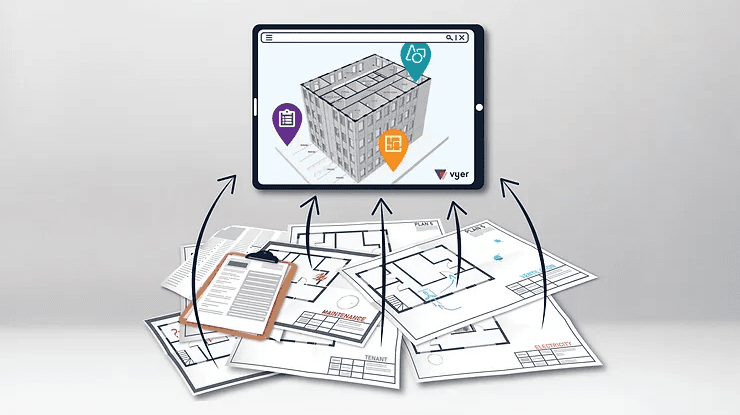
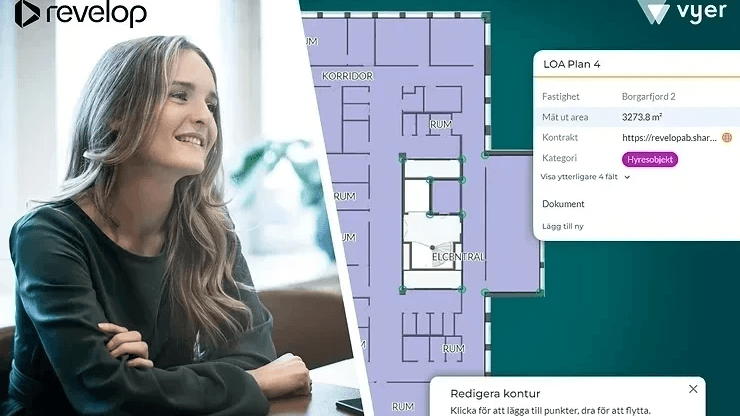
Industry experts' tips: "Create a culture with processes and routines that support digitalisation."
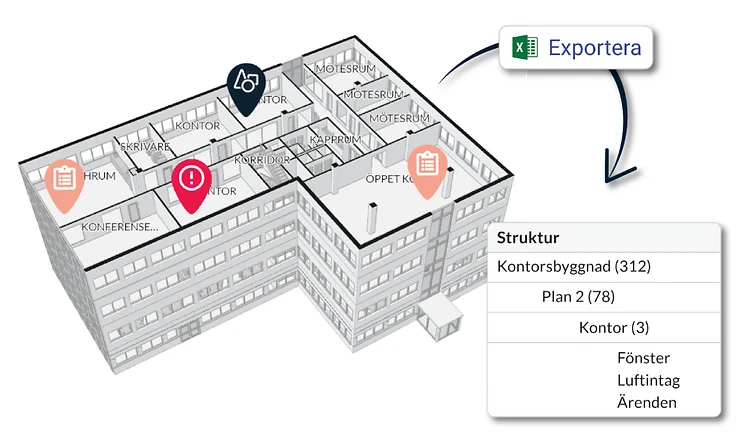
Real estate and information structure in digital twin. Illustration: Vyer
More property owners are investing in streamlining their operations with digital twins. To increase knowledge about how property owners can work for a smooth transition from analogue to digital ways of working, we are interviewing various industry players who share their ideas. Next up: Viktor Davidov, group manager in Proptech at Sweco.
"The most exciting thing right now is that there is a sense of urgency in the industry; property owners have understood that they need to invest in digitalization. Several factors have contributed to this: new blood in the industry, high interest costs, taxonomy, and sustainability issues," he says.
Viktor Davidov, group manager in Proptech at Sweco.
Currently, Viktor Davidov leads a group in Proptech & Digital Strategy at Sweco, focusing on helping property owners take advantage of the opportunities presented by digitalization.
"There are many tools that can accelerate the digital transformation, but you also need an organization that can receive the technology and understands the value for it to scale. This means you need to train employees and create a culture with processes, working methods, and routines that support digitalization."
5 tips for property owners looking to digitalize
Decide what you want to strive for. Do you want to become the most sustainable, customer-oriented, or profitable company?
Look at what problems you have today. Can you address these problems? Do you have the right organization for it? Do you have the right people in place, or do you need to look around for completely new roles?
Find a system that matches your needs. Look at what you have internally today and what you have externally. Do you need a new system? What should the system do? If you bring in a new system, you want to remove at least two existing ones.
Establish processes and activities that support what you want to achieve. For example, if you're purchasing a system where employees can request updates of drawings, you need a process for how you will procure the system to update the model.
Raise the level of knowledge in the organization. Continuously showcase what you are doing and let employees who have been involved from the start help train their colleagues.
Source: Viktor Davidov

Viktor Davidov, group manager in Proptech at Sweco.
New processes, working methods, and routines as support to the technology
His advice is to first let the management settle on what needs to be done and why so they can push it through, then involve employees who have a genuine interest in digitalization.
"Start with a few properties and work closely with technical property developers, operational technicians, and stakeholders around you, and set up a process for how you will work in the system. Then you can see what challenges arise and solve them so that the childhood diseases are gone when it's implemented on a larger scale. Show what is being done; it raises interest among more in the organization."
The idea is that when the system is then applied to more properties, those employees who were the first to start working with it can be involved in training their colleagues.
"That's when it takes off; it grows organically. That is how I believe we should work: let it take its time and have patience and understand that it is people who need to go through the emotional dip of resistance and acceptance," he says.
Democratization of information for increased insight
Viktor Davidov works, among other things, with the implementation of digital twins at property owners who want to collect and make information available to streamline operations and management.
"For those implementing Vyers twins, we focus on the property structure (property, building, floor, room), as well as areas and equipment. It serves as a spatial database where information is gathered and cross-fertilized from different sources. The digital twin then evolves over time, allowing you to view the property from various angles."
Digitalization is largely about democratizing information so that the entire organization can access it and benefit from it in their work.
"Digital information flows make everything faster; you can trust the information and validate it. Most importantly, you can gain more insight into how your properties are performing and have more eyes to address challenges – and when you are sick, your colleague can just click and see the information."
Digital twin for value creation
Technical systems, processes, and working methods together create the structure required for property owners to build and maintain the information in the digital twin.
With relevant data just a click away, it enables a streamlining of management processes such as troubleshooting, rounds, energy measurement, reporting, and operational monitoring. It also becomes easier to respond to tenants' questions and share necessary information.
"There is a clear path for property owners to become more customer-oriented, profitable, and sustainable. With better control over our information, our organization, and our way of working, we will not waste as many resources," says Viktor Davidov.
Sustainability in the property industry is not just about reuse and sustainable materials, but also about how we work, he argues.
"The reporting itself should also be sustainable; it is not today. As a sustainability manager, you should set a vision for where we are going and how we execute it, not call around looking for data sources. The data should be there so you can do something more value-creating. Spending time on the right things is sustainability for me."
How do you think the future will look?
"I believe that the digital representation of your property will be worth more than the physical property. For all the history and knowledge contained in the database, the digital twin costs more to recreate than it costs to build an exact replica of the property," says Viktor Davidov, adding:
"Then the financial side still needs to understand that this is an investment, not a cost, because it will be expensive not to do it."