6 tips for property owners who want to succeed with digitalization

There are many things to consider before, as a property owner, investing in new digital services. Here we list some of the questions that may be good to discuss to see how well your needs and objectives match with what the proptech provider can offer.
1. What do you want to achieve?
When purchasing a new service, it is essential to know why and to think long-term. Digitalization takes time, and adopting technology merely because it is new and exciting is short-sighted. Consider what benefits you want to achieve and let this guide your choice of technology. A service that creates clear benefits for employees will be used; this is a prerequisite for achieving effects in your operations and for creating new values related to the property business.
“The advantage of a SaaS service is that it is constantly evolving, and you get to participate in that development. It becomes a combination of what all customers desire”
Jesper Hedlund, Development Leader & BIM Manager at Örebroporten
2. What needs are there?
Depending on where you are in the digitalization process, needs may vary. Some property owners are still working with paper drawings. The first step may then be to start modernizing the drawing base to more easily keep the drawings up to date when renovations and remodelling are carried out. If you already have BIM drawings, the focus may instead be on organizing your building information to facilitate work in operations and management. The BIM drawings can, after some adaptation, for example, function as a hub for gathering, structuring, and making information available in a shared interface where the organization can collaborate to add and update it over time. In the long run, it is also possible to use aggregated data to make better analyses and decisions regarding maintenance and purchases, something that several property owners are requesting.
“A continuous flow of information that remains relevant throughout the property’s lifecycle can save us millions”
Malin Lampa, Development Manager at Mimer.
3. What information exists and where is it stored today?
It is good to inventory your existing information structure before purchasing a new service. Here you can review what information you have access to, where you are currently storing it, and how the usage of the systems you have looks. Are there systems that are not being used? What do you think the reason is? Can the new service replace such a system? Which systems are working well? Is there information that you are currently missing that you would like to have access to? Investigate the organization’s needs to gain a deeper understanding of what information is important in their roles.
4. Does the provider offer opportunities for integration with other systems?
Working in many different systems is time-consuming, so many property owners are moving away from the old silo mentality. For a property to become smart, different systems and sensors must be able to communicate with each other so that the information only needs to be updated in one place. A prerequisite for this to work is that the provider can supply APIs (application programming interfaces) that are compatible with other complementary services. Even if you currently do not have a concrete vision of what your infrastructure should look like, it is valuable to prepare for the future and ensure that integration possibilities exist so that you are not locked into a single system.
5. How can the new technology complement existing systems?
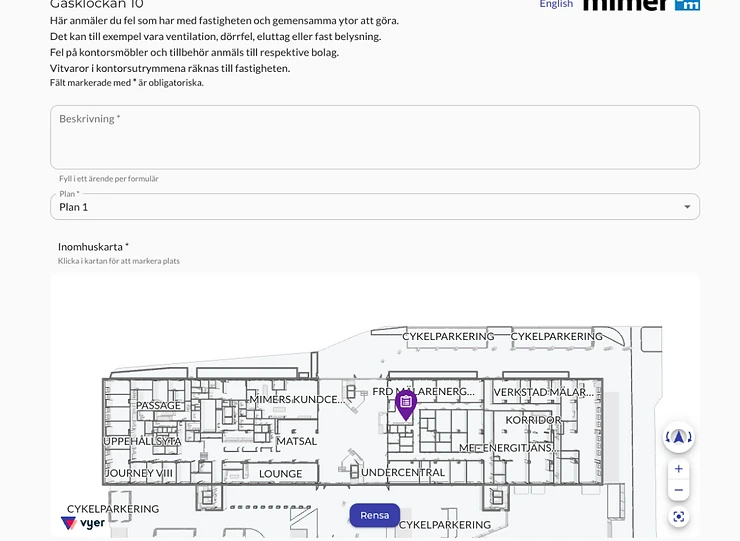
A property system that is supposed to manage everything is a thought that many property owners have begun to leave behind. Instead, consider which systems you have that work well and that you want to keep, and how the new technology can complement these. Investigate whether existing providers have open APIs or if it is something they are willing to offer. This opens up exciting solutions where systems can benefit from each other. For example, a service that provides location-based information can be linked with an existing case management system, which allows tenants to report issues on a map, simplifying both handling and localization on-site.
“The strength lies in the ecosystem where the spatial database, the twin's geographical details, becomes the hub that is connected with harmonized data from other systems”
Fredrik Hörnsten, CDO at Hemsö
6. How do you create the conditions for the organization to use the technology?
Digital technology in itself is not a guarantee for change; it is only when it is used by people that something happens. The user-friendliness of the technology is therefore fundamentally important. If it is complicated to keep the information up to date, it will quickly become outdated. A pilot project where the technology is applied to a few properties and employees can therefore be a good way to investigate whether the system is user-friendly.
Do employees like the technology? Does it generate engagement? Do they see benefits from the system in their daily work? If the answers are yes, it is a positive indication that the rest of the organization will agree. Furthermore, there is a good chance that those who have already tested the system will act as inspiration for other employees. Ultimately, there must be a willingness to change habits and behaviors—curiosity and simplification drive digitalization forward.